- Full Moon was yesterday (and even a partial lunar eclipse), today the Moon was waning gibbous (Illuminated fraction: 0.993 Phase: 350°)
- Some seeing visible on the Moon's limb (in both the 150/750 and the 114/500), still not sure if this is atmospheric seeing or tube seeing
- The 114/500 has awful stray light problems. It depends a bit on where the Moon is in the FOV, and at what angle one looks into the eyepiece. I then looked into the focuser's tube without an eyepiece: The body of the secondary is made from shiny plastic – what could possibly go wrong with such an design??? Well for one thing: the light passing the plastic obstruction before hitting the primary is glaring, which is visible through the focuser tube (when viewed without an eyepiece). And secondly the area around the secondary is visibly shiny when viewed through the focuser.
- The 150/750's secondary has an similar plastic body, but much less problems. I will have to baffle both, I'm afraid…
- Plato Crater really stands out quite dark from the somewhat brighter Montes Alpes.
- The Moon is a good target to asses things like stray light and focusing.
- I'm so glad to have bought the 150/750 Newton! 6-inch vs. 3-inch means twice the resolution and four times the light gathering. Can't wait to take a shot at Jupiter, and the Andromeda galaxy.
- My eyepieces are fogging over. Had to take a break and put the eyepiece case inside to warm up again… (Maybe I'm dressed a bit too warm, as I'm slightly sweaty…)
- I wanted to hold out and view Jupiter – but I got unbearably tired, my muscles started to hurt and clouds started to roll in – so I packed up again.
- I ask for only one thing: A house in the south of France…
Showing posts with label Moon. Show all posts
Showing posts with label Moon. Show all posts
Saturday, October 19, 2013
Plato Crater, Stray Light
Just doing a quick observation session, the full Moon beckons, and the weather is (almost) good.

Thursday, October 17, 2013
Crater Aristarchus, Swamp Valley and Thermal Management
Yesterday I made a short observation session: the weather was not favourable and the (only halfway) possible target was the Moon.
The Moon was Waxing Gibbous (illuminated fraction: 0.946, phase: 27°) and Crater Aristarchus really stood out near the Western limb of the Moon.

First of all the material inside the crater has apparently an higher albedo. And secondly: the area surrounding the crater is viewed (and illuminated) at an highly oblique angle – therefore it is dimmer than the crater wall, which is positioned at an more favourable angle. An really outstanding crater!
Having the 6-inch Newton really payed off, one can go to higher magnification and see so much.
There was some slight seeing, which might have been tube seeing. If I had more energy I would rebuild the 150/750 Newton, with better thermal management and making sure there are no distracting tube currents (see here, here, here, here, here, here and here). And I would use a low-profile focuser to be able to increase the distance between primary and secondary slightly (in order to get a bigger "FIF", fully illuminated FOV).
While the 6-inch Newton was left to cool outside for some time (same as last time), I kept my eyepiece case in the warmth this time until I started observing. I had no problems with fogging over of the eyepieces. But the sky kept fogging over…
The rising Moon in the East was visible through some semi-transparent clouds, which started to break up from the West – hurray! When the "clear" sky started to reach the Moon, a foggish something started to roll in from the North (up valley from me) – boo! Apparently I live in a swamp valley… If I had unlimited funds for astronomy, the first thing I would buy is a house in the South of France. La Midi invite!
The mount was quite shaky this time, the balance of theRA DEC axis wasn't quite right and last time I put some weight on the tripod itself. But the main culprit is some slack in the worm gear of RA DEC axis. I think this is the last problem of this mount, getting rid of the slack in RA DEC drive. I think removing the Chinese Grease™ from the worm drive was a mistake. But I have a disgust of opening up the EQ-3-1 again, and breaking another worm-drive – one broken worm drive is enough for a lifetime…
The Moon was Waxing Gibbous (illuminated fraction: 0.946, phase: 27°) and Crater Aristarchus really stood out near the Western limb of the Moon.
Crater Aristarchus, as seen by the Galileo spacecraft
(Link to blog source for this cropped image omitted due to "loony ideas" being spread there. Original is from NASA/Galileo spacecraft during its Earth flyby, hence the unusual vantage point.)
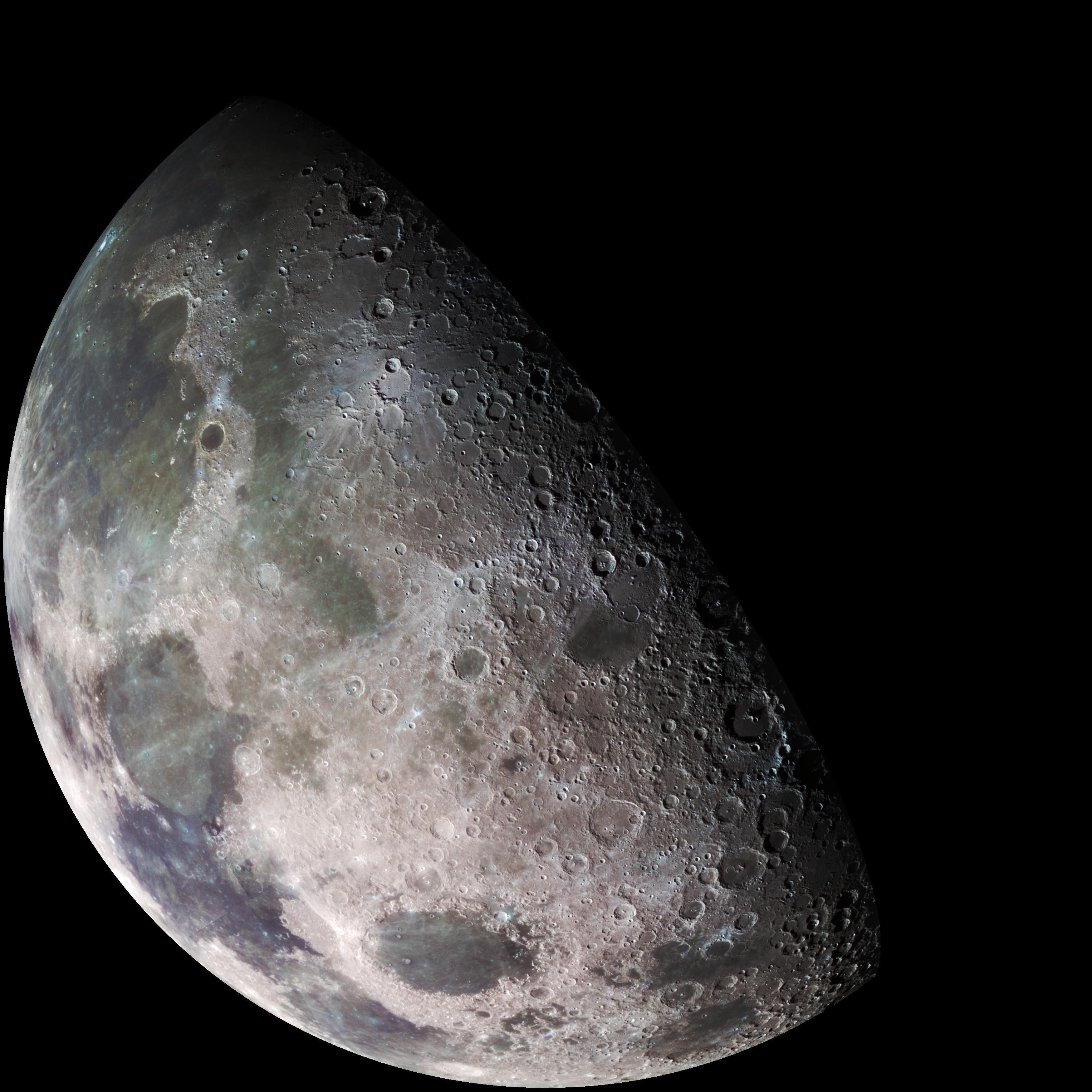
First of all the material inside the crater has apparently an higher albedo. And secondly: the area surrounding the crater is viewed (and illuminated) at an highly oblique angle – therefore it is dimmer than the crater wall, which is positioned at an more favourable angle. An really outstanding crater!
Having the 6-inch Newton really payed off, one can go to higher magnification and see so much.
There was some slight seeing, which might have been tube seeing. If I had more energy I would rebuild the 150/750 Newton, with better thermal management and making sure there are no distracting tube currents (see here, here, here, here, here, here and here). And I would use a low-profile focuser to be able to increase the distance between primary and secondary slightly (in order to get a bigger "FIF", fully illuminated FOV).
While the 6-inch Newton was left to cool outside for some time (same as last time), I kept my eyepiece case in the warmth this time until I started observing. I had no problems with fogging over of the eyepieces. But the sky kept fogging over…
The rising Moon in the East was visible through some semi-transparent clouds, which started to break up from the West – hurray! When the "clear" sky started to reach the Moon, a foggish something started to roll in from the North (up valley from me) – boo! Apparently I live in a swamp valley… If I had unlimited funds for astronomy, the first thing I would buy is a house in the South of France. La Midi invite!
The mount was quite shaky this time, the balance of the
Subscribe to:
Posts (Atom)